
ERIA Workshop Showcases AI, Blockchain, and Energy Storage to Power ASEAN’s Smarter, More Resilient Grid
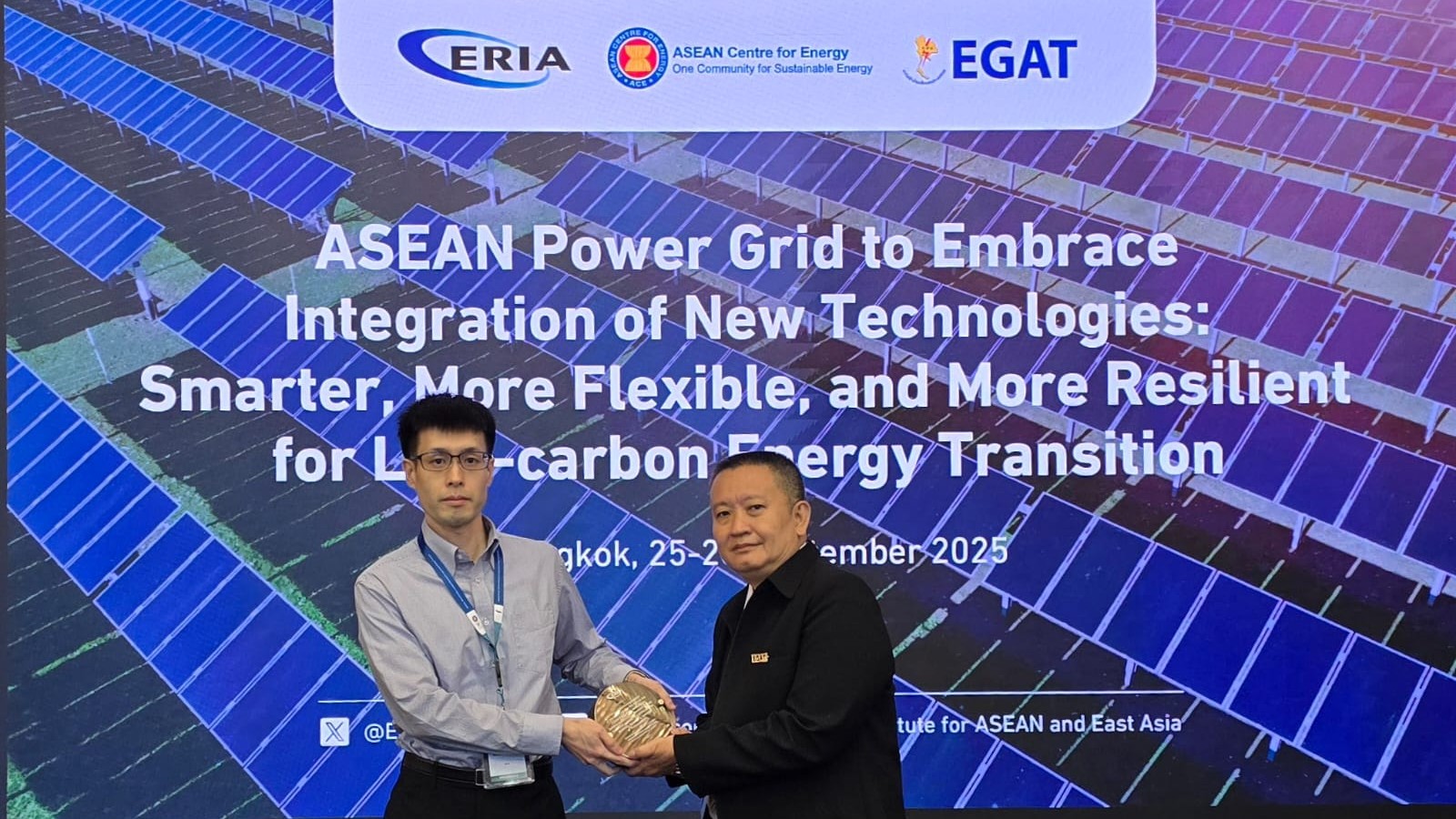
Bangkok, 26 September 2025: ERIA, in collaboration with the ASEAN Centre for Energy (ACE) and the Electricity Generating Authority of Thailand (EGAT), convened the Second Regional Workshop on the ASEAN Power Grid (APG) and New Technologies on 25–26 September 2025 in Bangkok, Thailand.
The workshop gathered representatives from ASEAN power utilities, energy experts, and consultants to advance regional dialogue on integrating emerging technologies into the APG framework to support ASEAN’s low-carbon energy transition.
Opening the event, Dr Nuki Agya Utama, Director for Energy Policy and Head of the ASEAN Zero Emission Center (AZE Center) at ERIA, underscored that the ASEAN Power Grid is 'not merely an infrastructure initiative, but a symbol of regional solidarity that must evolve with innovation to become smarter, more flexible, and more resilient.'
Dr Kornkiat Charoenpatcharakij, Director of Power System Planning at EGAT, welcomed participants and emphasised the importance of sustained regional co-operation and knowledge sharing in shaping ASEAN’s energy future.
Key Discussions
The first day featured a validation workshop with presentations across four key technology areas:
- Supply-side Technologies – Ricardo PLC and UNITEN Malaysia introduced a regional roadmap for APG development, from initial pilot projects and stability measures to harmonisation and eventual regional market integration.
- Artificial Intelligence (AI) – Deloitte Tohmatsu Risk Advisory explored AI applications for demand forecasting, grid monitoring, and predictive maintenance, identifying promising AI tools for transmission system operators.
- Energy Storage Technologies – TEPCO Power Grid outlined global trends and ASEAN’s current status, recommending battery energy storage systems (BESS) deployment to enhance renewable integration.
- Blockchain – Nanyang Technological University presented blockchain-based models for peer-to-peer energy trading and decentralised pricing, proposing a dual-track roadmap combining APG development with pilot tests of decentralised systems.
Dr Li Yanfei, Research Fellow at ERIA, closed the day by stressing the need to align technological pathways with national contexts and regional prioritiesfor a coherent clean energy transition.
Technical Visits
On the second day, participants observed practical applications of smart grid and energy technologies during technical visits in Bangkok.
At EGAT’s Control Center in Nonthaburi, they explored the Renewable Energy Forecast Center (REFC) and Demand Response Control Center (DRCC), witnessing the use of AI in forecasting and demand-side management.
At the Metropolitan Electricity Authority (MEA) Zero Energy Building Center, participants saw real-world applications of energy efficiency, BESS integration, and smart grid technologies in urban environments.
Outcome
Through a blend of technical exchange and site demonstrations, the workshop provided a platform for ASEAN Member States and partners to validate study findings, share insights, and foster regional collaboration in building a smarter, more resilient, and low-carbon ASEAN Power Grid.


