
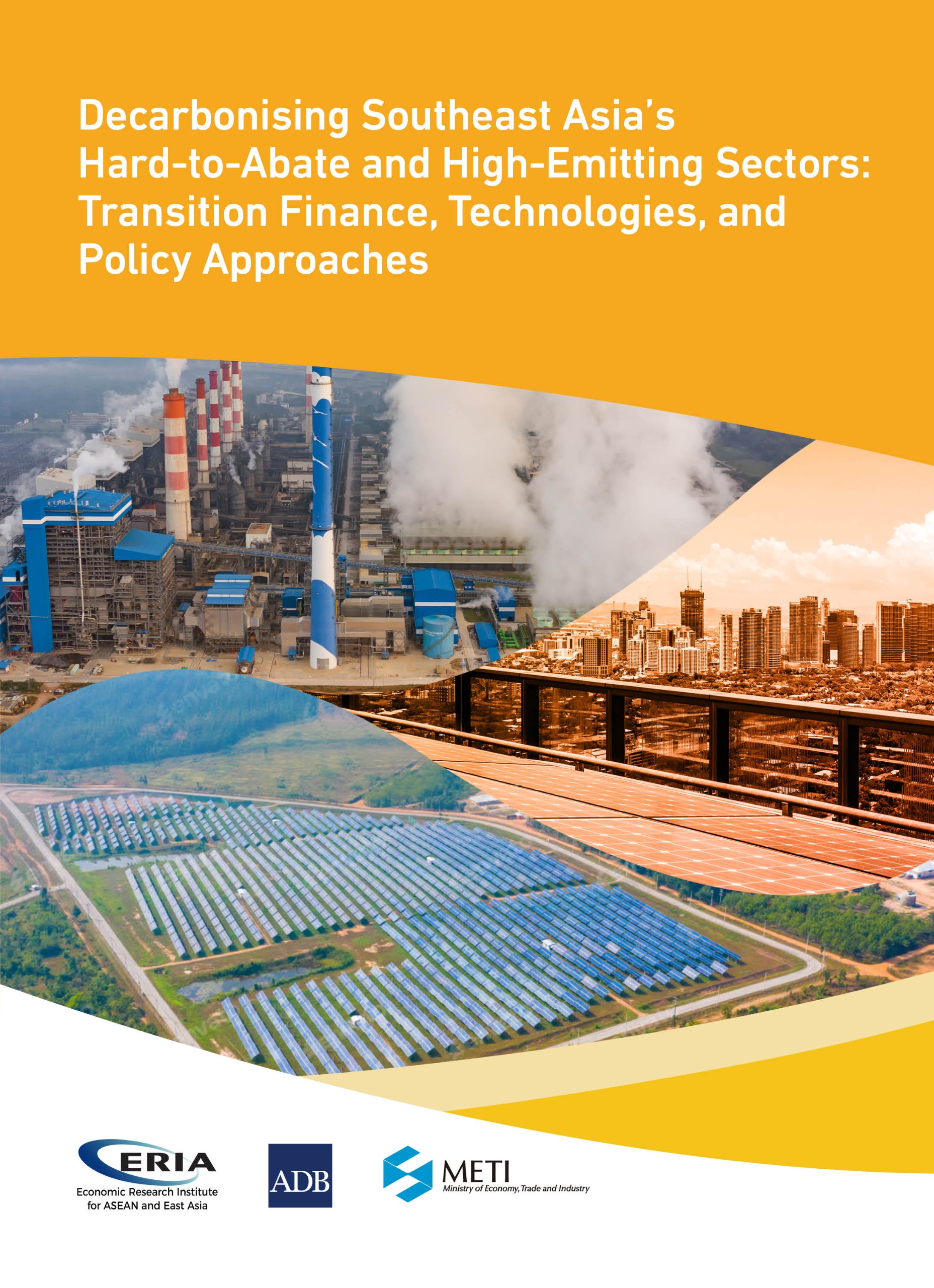
This joint book by ERIA, ADB, and METI examines the evolving role of transition finance, technology, and policy in supporting the decarbonisation of Southeast Asia’s emissions-intensive sectors such as power and heavy industry – the so-called ‘high emissions’ and ‘hard-to-abate’ sectors, respectively. These sectors are highlighted in high-level roadmaps that identify key investment areas for a pragmatic energy transition.
As countries in the region pursue their net-zero targets, financing credible and inclusive transition pathways has become increasingly urgent in these sectors. The study reviews the current landscape, identifies challenges, and highlights emerging practices for mobilising transition finance within Southeast Asia’s unique energy, financial, and industrial contexts. It also assesses transition activities and enablers such as sustainability-linked instruments, blended finance, and policy support.
The book showcases in-depth case studies across Southeast Asian countries that illustrate real-world experiences, covering both green and transition-aligned technologies in scaling-up renewables, building green-enabling infrastructure, and decarbonising hard-to-abate and high-emitting assets.
The book calls for strong regional cooperation amongst policymakers, financial institutions, industry actors, and other stakeholders to ensure a just and credible transition towards low-carbon economies in Southeast Asia. It places strong emphasis on first-of-a-kind projects in sectors without commercial precedents, supported by governments in the region, developed-country trade partners, and multilateral development banks. Regional initiatives such as the Asia Zero Emission Community (AZEC) are highlighted as crucial platforms to harmonise technical standards, align policy frameworks, support infrastructure planning, and crowd in financing.
Finally, the book proposes the establishment of regional standards and financing mechanisms for early-stage industrial decarbonisation, designed to channel concessional capital, catalyse blended finance, and facilitate cross-border investments to address the energy trilemma and support a just energy transition.
Related Publications

