
From Frameworks to Finance: Turning ASEAN’s Transition Pathways into Bankable Projects
Singapore, 29 October 2025: At the Asia Clean Energy Summit (ACES), held as part of the Singapore International Energy Week, ERIA as the secretariat of the Asia Transition Finance Study Group (ATFSG) shared insights on mobilising the capital required for energy transition projects.
The event was opened with remarks from the Ministry of Economy, Trade, and Industry (METI) of Japan, followed by:
- a presentation by the International Energy Agency (IEA) about its report titled Scaling Up Transition Finance,
- a presentation by Mr Sho Hayashi (Policy Fello on Energy Transition and Finance at ERIA) on an ADB–ERIA–METI joint report titled Decarbonising Southeast Asia’s Hard-to-Abate and High-Emitting Sectors: Transition Finance, Technologies, and Policy Approaches, and
- a panel session on Transition Finance in ASEAN by the members of ATFSG.
During the joint report presentation, Mr Hayashi highlighted the importance of supporting all three key investment themes – renewables, enabling infrastructure, and hard-to-abate sectors. He also called for stronger collaboration amongst policymakers, industry, and financial institutions to accelerate Asia’s transition.
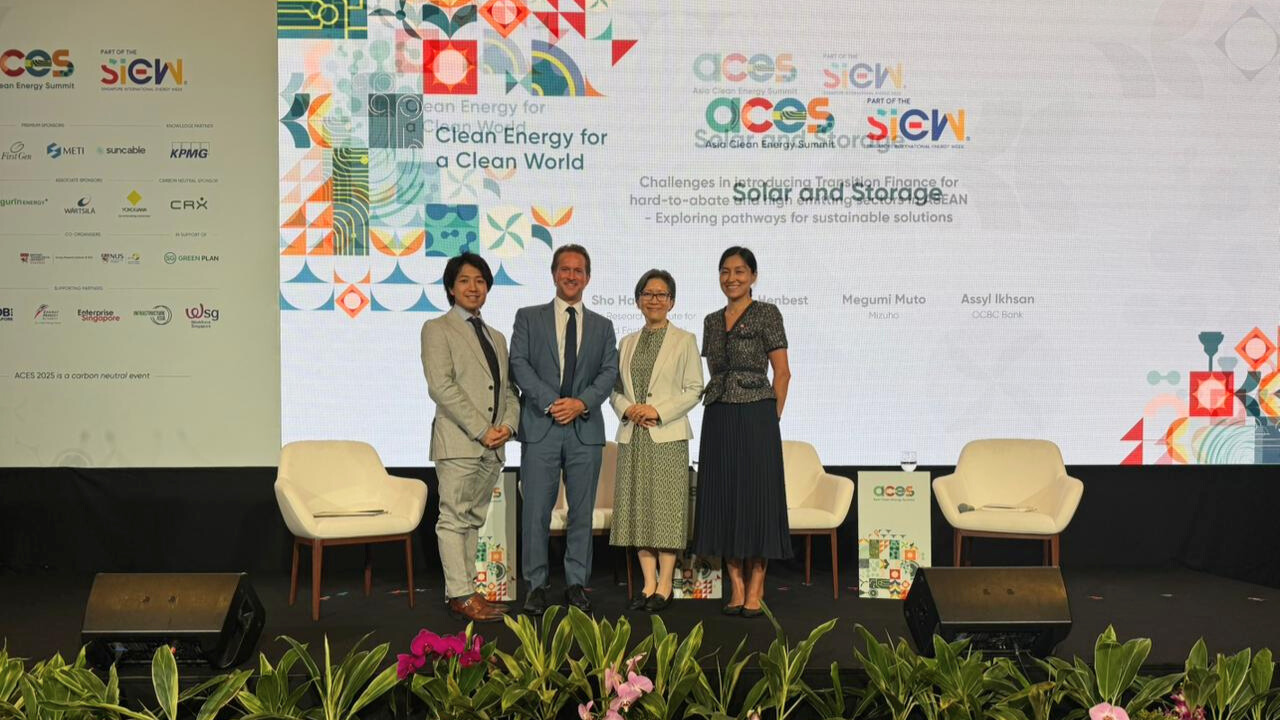
The subsequent panel discussion brought together leading experts from the financial sector to exchange views on how to scale up investment for hard-to-abate and high-emitting sectors in the region. Moderated by Mr Hayashi, the session featured:
- Ms Assyl Ikhsan, Executive Director for Sustainability Solutions at OCBC Bank,
- Mr Seb Henbest, Global Head of Climate Transition at HSBC, and
- Ms Megumi Muto, Deputy Chief Sustainability Officer at Mizuho Financial Group.
The panel explored how financial institutions can balance decarbonisation and economic growth by mobilising capital toward credible transition projects. Speakers discussed the importance of clear policy and regulatory frameworks, predictable revenue structures, and effective risk-sharing mechanisms such as blended finance. They also highlighted the need for greater public–private collaboration to accelerate investment in hard-to-abate industries, including power generation, steel, and cement.
Throughout the discussion, participants agreed that transition finance is an essential tool for Asia’s pragmatic energy transition, allowing countries to pursue diverse pathways toward sustainability. In closing, the moderator emphasised that the next step is to move from concept to implementation by translating transition finance frameworks into bankable, region-specific solutions that reflect the realities of ASEAN economies.
.jpg/)
.jpg/)


